
JointBrex Ingredients List: 7 Checks on Every Label Line
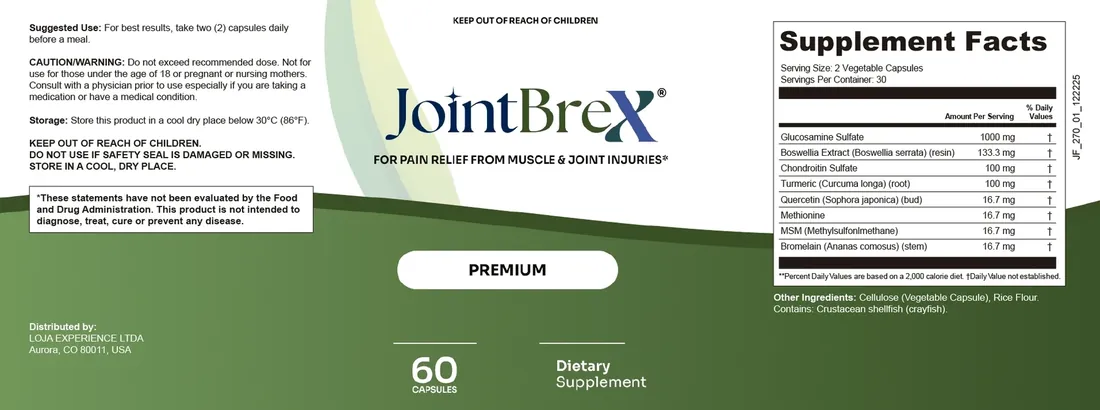
JointBrex lists eight active ingredients per two vegetable capsules: glucosamine sulfate 1,000 mg, boswellia extract 133.3 mg, chondroitin sulfate 100 mg, turmeric root 100 mg, and 16.7 mg each of quercetin, methionine, MSM and bromelain. It contains crustacean shellfish (crayfish).
Key facts
- JointBrex is a capsule. No gummy or liquid form appears in the brand materials.
- Serving size is 2 vegetable capsules. There are 30 servings and 60 capsules in a bottle.
- Added up, the active ingredients weigh about 1,400 mg. Glucosamine is about 71% of that.
- Besides the actives, the capsule holds cellulose for the shell and rice flour.
- The label says: Contains crustacean shellfish (crayfish).
- Only boswellia sits inside its studied dose range. How the boswellia extract is standardized is not published.
- Daily Value is not established for any of the eight ingredients.
What is JointBrex, and what is in the capsules?
JointBrex is a dietary supplement that comes as vegetable capsules. You get 60 in a bottle. The label directs two capsules daily before a meal, so one bottle lasts 30 days. There is no gummy, pill-press tablet or drop form on the label we cover.
Some shoppers search for “jointbrex gummies” or “jointbrex drops”. We found no such product in the brand materials. If a seller offers a gummy or a liquid under this name, match it against the real label before you pay.
The rest of this post is a checklist. It walks down the Supplement Facts panel one line at a time. At each line we ask a simple question, so you can hold the bottle in one hand and tick the boxes with the other.
Check 1: Does the serving line read 2 vegetable capsules?
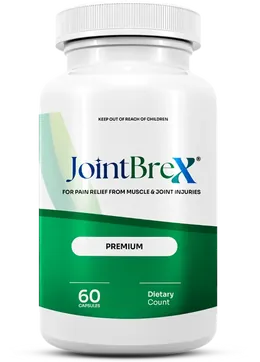
Start at the top of the panel. It should say the serving size is two vegetable capsules, with 30 servings per container. That matches the front of the bottle, which says Premium and 60 capsules.
This line also tells you the cost of one serving. A bottle holds 60 capsules, so at two a day it lasts 30 days. Price per bottle, divided by 30, gives the daily cost for a pack.
If the serving on your bottle says something different, stop and compare. The name should read JointBrex, the word Premium should be on the front, and the count should be 60. The name Gold is a different label, and we cannot confirm that it is the same product.
Compare it with your own bottle
The order page shows the packs and the total. The label facts above are what you should see on the bottle when it arrives.
Jointbrexformula earns money on orders placed through this site.
Check 2: Does glucosamine sulfate come first at 1,000 mg?
It should. Glucosamine sulfate is the biggest line, at 1,000 mg per two capsules. It makes up about 71% of the active weight, so this is mainly a glucosamine product with smaller helpers around it.
Glucosamine is an amino sugar that your body makes. Supplement glucosamine is usually made from shellfish shells, and the label points to crayfish. Most trials used 1,500 mg a day, so 1,000 mg is about two thirds of the studied amount.
The large GAIT trial gave 1,583 adults with knee osteoarthritis 1,500 mg a day for 24 weeks. Glucosamine did not beat placebo overall. The 2019 ACR guideline strongly recommends against glucosamine for knee and hip osteoarthritis.
Check 3: Is boswellia the second line at 133.3 mg?
Yes. Boswellia extract (Boswellia serrata, resin) is listed at 133.3 mg. It comes from the resin of a tree also called Indian frankincense. Each capsule therefore carries roughly 67 mg.
This is the one ingredient whose amount lands inside the studied range. Pooled trials used 100–250 mg of extract a day. The 2020 Yu review covered 7 trials and 545 people and found lower pain and stiffness scores than control, but results varied a lot.
Check 4: What do the chondroitin and turmeric lines tell you?
Chondroitin sulfate and turmeric root are each 100 mg. Both are small next to research doses.
Label amount next to the research reference
| Ingredient | JointBrex per 2 capsules | Research reference |
|---|---|---|
| Glucosamine sulfate | 1,000 mg | 1,500 mg a day in GAIT |
| Chondroitin sulfate | 100 mg | 800–1,200 mg a day in trials |
| Boswellia extract | 133.3 mg | 100–250 mg a day extract |
| Turmeric root | 100 mg | About 1,000 mg a day of curcumin in meta-analyses |
Turmeric needs one more note. The label says root, which is plain ground spice. It is not a curcumin extract, and no black pepper is listed. Root powder holds only part curcumin, so the curcumin in a serving is well below 100 mg. The sales page calls this ingredient “curcumin”. The bottle label is the better guide.
Check 5: Are the four small add-ins each 16.7 mg?
Quercetin (Sophora japonica, bud), methionine, MSM (methylsulfonylmethane) and bromelain (Ananas comosus, stem) are each 16.7 mg. Together they weigh about 67 mg.
These four are tiny. The one MSM knee trial used 3,375 mg a day, so 16.7 mg is about 0.5% of that. Bromelain was studied at 540 mg or more. Quercetin was judged safe at 500 mg a day by a Norwegian review. For methionine, no joint dose was found.
Small amounts are not harmful in themselves. They do make it unlikely that these four do much on their own at this dose. We treat them as extras, not as the reason to buy. Our MSM and add-ins checklist goes deeper.
Check 6: Do you see the other ingredients and the allergen line?
Below the panel, the label lists other ingredients: cellulose, which forms the vegetable capsule, and rice flour. Then comes the allergen line: “Contains: Crustacean shellfish (crayfish).”
That line matters. U.S. rules treat crustacean shellfish as a major allergen and ask for the type to be named. Glucosamine comes from the shell, and it should hold very little of the protein that causes reactions. Allergists call the risk likely very low but not zero. If you have ever reacted to crayfish, shrimp, crab or lobster, talk to your allergist before the first capsule.
Two more label facts help. The capsule shell is plant cellulose, but the product is not vegetarian, because glucosamine comes from crayfish shell. And Daily Value is not established for any of the eight ingredients, which is why the panel shows a dagger instead of a percent.
Check 7: Do the distributor, storage and caution lines match?
The last check is the small print around the panel. Your bottle should show these lines.
- Directions: take two capsules daily before a mealLabel
- Caution: do not exceed the recommended doseLabel
- Not for under 18, pregnant or nursing; ask a physician first if you take a medicineLabel
- Store below 30°C (86°F); keep away from childrenLabel
- Do not use if the safety seal is damaged or missingLabel
- Distributed by Loja Experience LTDA, Aurora, CO 80011Distributor only
- Manufacturer name and an independent lab certificateNot published
The label names a distributor, not a manufacturer. The lot and best-before date are on the base when the bottle shows them. A reference lot and CoA code are printed as JOI-26/JO-4762 and JOI-4762-26-JO. Treat them as codes to quote when you call, not as lab results.
Where can you keep reading?
Ingredients
All eight label ingredients with amounts, the shellfish line and how each dose compares with research.
Read more →Supplement facts
The Supplement Facts panel line by line, plus the label text, the allergen line and the front claim.
Read more →Batch check
Lot and CoA references explained, label lines to compare and how to ask for a lab certificate.
Read more →Frequently asked questions
What are the ingredients in JointBrex?
A serving of two capsules carries glucosamine sulfate (1,000 mg), boswellia extract (133.3 mg), chondroitin sulfate (100 mg), turmeric root (100 mg) and four extras of 16.7 mg each: quercetin, methionine, MSM and bromelain. Cellulose and rice flour make up the rest.
Is there shellfish in JointBrex?
Yes. The label says “Contains: Crustacean shellfish (crayfish).” If you have a shellfish allergy, talk to an allergist before you take it.
Does JointBrex have a proprietary blend?
No. Each of the eight ingredients has its own printed amount, from 1,000 mg down to four extras at 16.7 mg each. That makes it easy to compare the label with research doses.
Is the turmeric in JointBrex the same as curcumin?
No. The label names turmeric (Curcuma longa) root, 100 mg, which is ground root. It is not a concentrated extract, and piperine from black pepper is not on the list.
Is there a JointBrex gummy or a liquid drop version?
Not in the brand materials we hold. JointBrex is sold as vegetable capsules, 60 to a bottle. If another form turns up, read its label before you pay.
Is JointBrex vegetarian?
No. The shell is plant cellulose, yet the glucosamine inside comes from crayfish shell, which the allergen line reveals. Chondroitin usually comes from animal cartilage too, though the label does not name its source.
Our view
A full label is the best thing JointBrex has going for it. Every amount is printed, and the allergen is named. That makes the product easy to check and easy to compare.
The same label also shows the weak spots. Glucosamine and chondroitin are below the doses used in trials. Turmeric is plain root, and the four extras are tiny. Only boswellia lands in its studied range.
So use the label as your guide. If you hold the bottle and every line matches, you know what you are getting. If you want proof of purity, ask the order desk for the certificate that matches your lot, and talk to your doctor before you start if you take any medicine.
Last updated October 16, 2026.
The label is the source of truth
If the amounts and cautions look right to you, see today's price and the guarantee on the order page. If any line puzzles you, ask the order desk first.
Jointbrexformula earns money on orders placed through this site.
